

What is Multi-Layer Privacy?
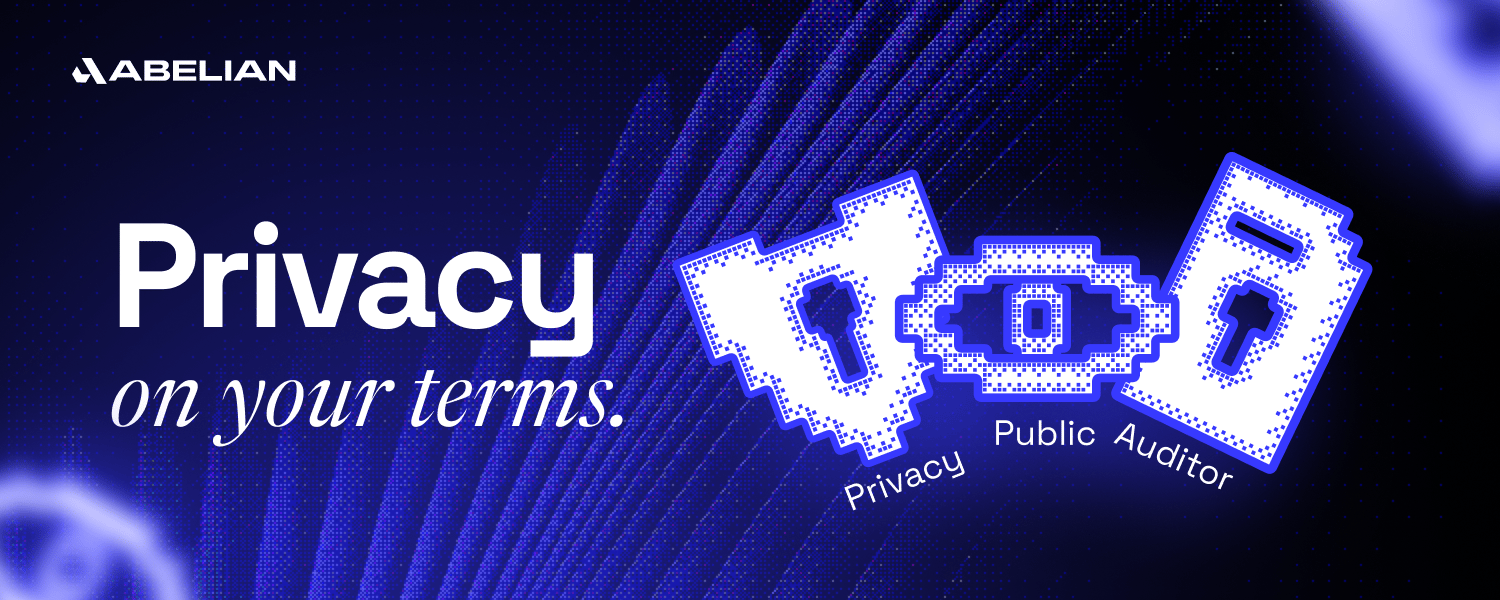
Your transaction history can reveal a lot about you: who you pay, how much you receive, and how much you hold. Not every payment needs to share all that information. Abelian’s Multi-Layer Privacy (MLP) gives you different ways to hold and transfer assets, depending on what you want to keep private and what you need to share. For ABEL, there are three privacy levels:- Transparent (aka pseudo-private CT): Publishes ABEL amounts and participating addresses so anyone can inspect payments and balances.
- Shielded (aka fully-private): Hides ABEL balances and amounts while obscuring the sender and protecting the recipient’s reusable address.
- Auditable (aka accountable): Keeps ABEL balances and amounts private from the public while letting a viewing-key holder inspect them without spending funds.
Privacy and Security Are Different
Security protects your funds from unauthorized spending. Privacy controls what other people can learn about your financial activity. Abelian uses post-quantum cryptography at every privacy level, including Transparent. Choosing a public transaction does not mean giving up post-quantum protection. Its cryptography is built on the same lattice (MLWE/MSIS) foundations as NIST’s ML-KEM and ML-DSA. Abelian uses its own cryptographic constructions on those foundations, rather than implementing those standards unchanged.Transparent: Public Activity, Pseudonymous Addresses
Transparent is the most open ABEL privacy level. Transfer amounts and participating addresses are publicly visible, allowing observers to follow activity and calculate balances. An address does not directly display its owner’s name. This is called pseudonymity, not anonymity. If someone connects an address to a person or organization, they can associate its public activity with that identity. Transparent can be useful when visibility is part of the purpose, such as a public donation address where contributors should be able to check incoming payments. Current Transparent mainnet addresses start withabe01007. Older documentation uses two names for Transparent wallets:
- Pseudo-private, with addresses starting with
abe01006. - Pseudo-private CT, with addresses starting with
abe01007.
abe01006 wallet type is obsolete and is being replaced by abe01007. Despite their different names and underlying wallet versions, both have the same privacy level. The current name for both is Transparent.
Shielded: Private Balances and Payments
Shielded provides privacy for ABEL balances and transfer amounts. It also obscures the sender and protects the recipient’s reusable wallet address. Several cryptographic components work together to provide these protections.Hiding the sender
Abelian uses lattice-based linkable ring signatures to hide the sender among a set of possible senders. The network can verify that a spend is authorized without publicly identifying which member of the set authorized it. The “linkable” property allows the network to detect an attempt to spend the same coins twice without revealing the legitimate sender’s identity. This is a specific privacy mechanism, not a promise of unlimited anonymity. The sender is concealed within a set of possibilities, rather than among every user on the network.Protecting the recipient
One-time addresses help prevent payments from being publicly linked to the recipient’s reusable wallet address. This complements the sender protection provided by ring signatures.Hiding amounts and balances
Cryptographic commitments and zero-knowledge proofs allow the network to check transaction validity without publishing the payment amount. Shielded wallet balances are also hidden from public view. Shielded is suited to situations where financial details should remain private, such as personal savings and confidential payments. Shielded mainnet addresses start withabe01005. Older documentation calls this wallet type fully-private.
Auditable: Private to the Public, Visible by Permission
Auditable privacy mode is currently not yet supported in the mobile app or desktop/CLI wallet. Support in those products is planned for the future.
- The wallet’s balance.
- The amount in all of the wallet’s transfers.
Privacy for Abelian User Tokens
Abelian User Tokens, or AUT, are assets issued on the Abelian network. Their privacy options differ from those available for ABEL. AUT use transparent host addresses, formerly called pseudo-private CT addresses. Both the sender’s and recipient’s addresses remain publicly visible, whether the AUT is Standard or Cloaked.Standard AUT
For Standard AUT, transfer amounts are public alongside the participating addresses. Observers can follow transfers and calculate token balances.Cloaked AUT
For Cloaked AUT, transfer amounts and token balances are hidden. The sender’s and recipient’s addresses remain public. The term Cloaked is dedicated to this AUT privacy option. It should not be used interchangeably with Shielded.Cloaked AUT Is Not Shielded ABEL
Cloaked AUT Is Not Shielded ABEL
The distinction is straightforward: Cloaked AUT hides how much is held or transferred, but does not hide the participating addresses.Shielded ABEL hides balances and amounts, conceals the sender among possible senders using linkable ring signatures, and protects the recipient’s reusable address through one-time addresses.If you send a Cloaked AUT, an observer can still see the addresses involved, even though they cannot see the amount. Do not assume that hidden amounts also mean hidden participants.
Choosing the Right Privacy Level
Use this guide to match the asset and visibility you need with an MLP privacy level.
MLP gives you options rather than a single privacy setting for every situation. The important step is understanding exactly what your chosen wallet or token type reveals.
Extra Resources:
- Blog: Multi-Layer Privacy, Quantum Defense: Blockchain’s Shift in the Web3 Era